

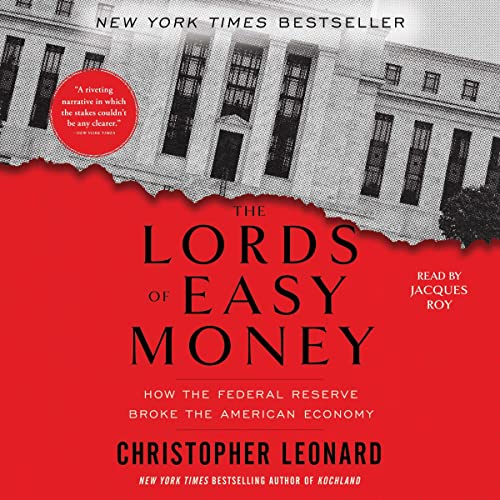
The Lords of Easy Money
How the Federal Reserve Broke the American Economy
Artikel konnten nicht hinzugefügt werden
Leider können wir den Artikel nicht hinzufügen, da Ihr Warenkorb bereits seine Kapazität erreicht hat.
Der Titel konnte nicht zum Warenkorb hinzugefügt werden.
Bitte versuchen Sie es später noch einmal
Der Titel konnte nicht zum Merkzettel hinzugefügt werden.
Bitte versuchen Sie es später noch einmal
„Von Wunschzettel entfernen“ fehlgeschlagen.
Bitte versuchen Sie es später noch einmal
„Podcast folgen“ fehlgeschlagen
„Podcast nicht mehr folgen“ fehlgeschlagen
Audible Standard 30 Tage kostenlos testen
Wähle pro Monat 1 Hörbuch aus unserem gesamten Katalog aus.
Hör deine ausgewählten Hörbücher, solange du Abonnent bist.
Hol dir unbegrenzten Zugriff auf beliebte Podcasts.
6,99 € pro Monat nach 30 Tagen. Monatlich kündbar.

The Lords of Easy Money
Gesprochen von:
Jacques Roy
Für 20,95 € kaufen
-
Gesprochen von:
-
Jacques Roy
-
Von:
-
Christopher Leonard
Über diesen Titel
If you asked most people what forces led to today’s unprecedented income inequality and financial crashes, no one would say the Federal Reserve. For most of its history, the Fed has enjoyed the fawning adoration of the press. When the economy grew, it was credited to the Fed. When the economy imploded in 2008, the Fed got credit for rescuing us.
But here, for the first time, is the inside story of how the Fed has reshaped the American economy for the worse. It all started on November 3, 2010, when the Fed began a radical intervention called quantitative easing. In just a few short years, the Fed more than quadrupled the money supply with one goal: to encourage banks and other investors to extend more risky debt. Leaders at the Fed knew that they were undertaking a bold experiment that would produce few real jobs, with long-term risks that were hard to measure. But the Fed proceeded anyway…and then found itself trapped. Once it printed all that money, there was no way to withdraw it from circulation. The Fed tried several times, only to see the market start to crash, at which point the Fed turned the money spigot back on. That’s what it did when COVID hit, printing 300 years’ worth of money in a few short months.
Which brings us to now: Ten years on, the gap between the rich and poor has grown dramatically, inflation is raging, and the stock market is driven by boom, busts, and bailouts. Middle-class Americans seem stuck in a stage of permanent stagnation, with wage gains wiped out by high prices even as they remain buried under credit card debt, car loan debt, and student debt. Meanwhile, the “too big to fail” banks remain bigger and more powerful than ever while the richest Americans enjoy the gains of a hyper-charged financial system.
The Lords of Easy Money “skillfully” (The Wall Street Journal) tells the “fascinating” (The New York Times) tale of how quantitative easing is imperiling the American economy through the story of the one man who tried to warn us. This is the first inside story of how we really got here—and why our economy rests on such unstable ground.
Das muss Grundbildung werden, damit die Politiker der Zukunft intelligente Entscheidungen treffen und es schaffen, die Lücke zwischen Arm und Reich zu verkleinern.
Alles beginnt mit Bildung.
Absolut relevantes Buch für Jeden!
Ein Fehler ist aufgetreten. Bitte versuche es in ein paar Minuten noch einmal.
geniale insight in weltwirtschaft und zusammenhang mit der fed
Ein Fehler ist aufgetreten. Bitte versuche es in ein paar Minuten noch einmal.
Everybody should listen to this
Ein Fehler ist aufgetreten. Bitte versuche es in ein paar Minuten noch einmal.